


Casatiello Recipe: Neapolitan Easter Bread With Salami, Cheese and Eggs
Casatiello is Naples’ signature Easter bread. A ring of dough rich with lard and black pepper, rolled up with salami, pancetta and cheese, with whole eggs baked on top in their shells, each held down by a cross of dough.
Every Neapolitan eats a ridiculous amount of it during Easter week. Every year, it’s the thing I look forward to most.
The short answer
- What it is: a savory Neapolitan Easter bread made with lard dough, salami and cheese, baked in a ring with whole eggs on top.
- When it’s eaten: around Easter. It’s easy to slice and carry, so it’s also the classic Easter Monday (Pasquetta) picnic food.
- Casatiello vs Tortano: on Casatiello the eggs sit whole on top; in Tortano they’re chopped and rolled into the filling.
- How many eggs: there’s no rule. Most people say an odd number: three or five.
- Timing: knead in the evening, let it rise overnight, then shape, proof and bake the next morning.
Five stars for fattening power
Here’s its profile: fattening power, five stars. Type: festive bread, Easter only. Natural habitat: the Naples area.
Honestly, its looks are as confusing as Colomba’s. If nobody explained it, you’d never guess what it is. But with ingredients like these, you can smell a Casatiello from three streets away. Delicious and off the charts in calories, guaranteed.
Where Casatiello comes from
Why is Casatiello the Easter food of Naples?
Christianity absorbed the spring equinox customs of ancient Rome and of farming communities even older than that. The equinox meant the earth waking up and new life being born, which fit neatly with the story of Jesus dying on the cross and rising three days later. It also kept the old way of celebrating: people gathering to share food.
Ancient Roman writings describe a leavened bread with eggs and cheese baked for the spring equinox, and many people believe that’s where Casatiello comes from. The Neapolitan Casatiello we eat today first appears in written recipes in the 17th century.
The Easter code hidden in the shape
- The eggs: the most obvious one. In folk belief, eggs meant spring and rebirth. They also stand for new life and the miracle of the resurrection.
- The cross on the eggs: the crucifixion, Jesus sacrificing himself for humanity.
- The ring: the cycle of life, and the crown of thorns.
- The pork: early farming communities sacrificed animals, and preserved the pork as salami, ham and lard. Casatiello uses several pork products, a sign of abundance and a wish for good luck.
- Pecorino: sheep’s milk feeds the lambs born in spring, so new life goes on. In Christianity, Jesus is the Lamb of God.
Flavor and symbolism, all in one loaf. You can see why Casatiello is the true love of the Neapolitan Easter table.
Casatiello vs Tortano
Naples has another lard bread that looks almost the same: Tortano. The difference is the eggs. On Casatiello they sit whole on top; in Tortano they’re chopped and rolled into the filling with the salami and cheese.
There’s also a sweet version, Casatiello dolce, an Easter cake.
Casatiello recipe
This makes one loaf in a ring tin, 16 cm (6 inches) across the bottom and 24 cm (9.5 inches) across the top. I use my own sourdough starter and knead everything by hand. No starter? No problem: there’s a poolish option below.
Ingredients
One ring tin (16 cm base / 24 cm top)
Dough
- Sourdough starterabout 70 g
- All-purpose flour†300 g
- Waterabout 225 ml
- Sugar1 tbsp
- Salt1 tsp
- Homemade lard3 tbsp
- Coarse black pepper1 tbsp
Filling
- Salame Napoliabout 70 g
- Pancettaabout 50 g
- Caciocavalloabout 50 g
- Cicoli (optional)to taste
- Pecorino or Parmesanto taste
- Coarse black pepperto taste
Topping
- Clean raw eggs, in the shell3–5
- Plain dough, set asidea small piece
† About 12.5% protein. Grate the Pecorino or Parmesan fresh.
No starter? Use a poolish
Poolish
Replaces 70 g of starter
Poolish
- All-purpose flour100 g
- Waterabout 100 ml
- Active dry yeast‡1 g
‡ Or 3 g of fresh yeast.
- Mix everything, cover loosely (not airtight).
- Leave it at room temperature in winter, or in the fridge in summer, for 8 to 12 hours, until the surface is full of bubbles and it’s roughly doubled.
- A poolish adds water, so cut the main dough to 200 g flour and 125 ml water.
Timing
This is my rhythm for any yeasted bread at home: knead in the evening and let it rise overnight; shape, proof and bake the next morning.
1. Knead: the semi-lazy method
No mixer? Don’t worry. Time is a great tool. Let’s use it.
- Mix the flour with the salt and black pepper.
- Add all the water and stir with a fork until there’s no dry flour at the bottom of the bowl. Cover and walk away for half an hour. Time is kneading for you.
- After 30 minutes, turn it onto the counter. It already has some strength. Tear the starter into small pieces and add it with the sugar (the sugar helps the fermentation along). Knead it in, with a few slaps against the counter. In under five minutes it comes together.
- Now knead until it’s perfectly smooth, right? Nope. Cover it and go rest for another 20 minutes.
- Come back and give it a few slaps. Smooth dough, clean hands.
- Now work the lard in, little by little. Poke it, knead it, fold it, slap it, like I do. This is the only part that takes a bit longer, and even then it’s under ten minutes.
- Once the dough has absorbed all the lard, cover it and rest another 20 minutes.
- It should now stretch into a thin windowpane. Give it a few last slaps and put it in an oiled container.
2. First rise
Let it roughly double. Italian winters are cold: my kitchen drops to about 8°C (46°F) at night, sometimes lower. I leave the dough by the window overnight and it’s doubled by morning. In summer, I let it rise slowly in the fridge overnight.
3. Fill it
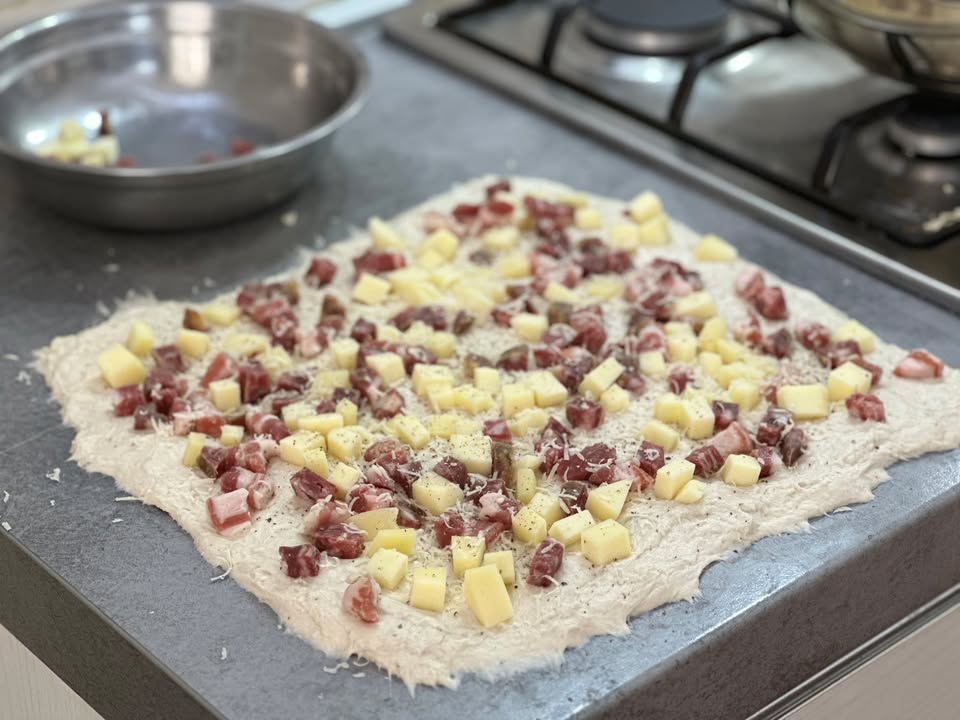
- The next morning, tip the dough out and deflate it gently.
- Stretch it into a rectangle about 40 × 30 cm (16 × 12 inches). The dough is super elastic. You can pull it around like a bedsheet.
- Scatter the salami, pancetta and caciocavallo evenly. No need to leave a border.
- Grate over plenty of Pecorino and grind on black pepper.
- Remember to save a little plain dough for the crosses on the eggs.
4. Roll it and add the eggs

- Roll it up from the long side, pulling it a little tight as you go so you don’t get big gaps that bake into a lopsided loaf.
- Pinch the seam closed. If the dough tears, don’t worry. The salami and cheese that poke out turn crisp and delicious in the oven. I sometimes tear it on purpose.
- Move it into a ring tin greased with lard and adjust the seam.
- Set the clean raw eggs on top, then stretch the saved dough into strips and lay a cross over each egg.
5. Second rise
Let it roughly double, about 40 to 60 minutes. In winter I put a small pan of hot water on the bottom of the oven (turned off) for warmth and humidity: about 40 minutes. In summer I just mist the top with water, no hot water in the oven: about 30 minutes.
6. Bake
- Bake at 175°C (350°F) for 35 to 40 minutes. Don’t turn the fan on yet, or the eggs will explode.
- Finish at 185°C (365°F) with the fan on for 10 minutes. Out comes a golden, crackly lard bread.

7. Let it cool (a little)
The hardest part of making Casatiello at home is waiting for it to cool down. The bits of cheese and salami sticking out always got picked off by me and my husband, Pasquale, while we waited.
If you rolled it evenly, there won’t be big holes inside, and the crumb will be dense and springy. The eggs on top are basically hard-boiled by the end. You can eat them.

How many eggs? Naples can’t agree
In my Pastiera video, I talked about the mysterious “rule of seven”: a proper pastiera supposedly needs seven strips, three one way and four the other. So I wondered: is there a rule for the eggs on Casatiello too? I’d never heard of one.
So I asked in a Neapolitan cooking group with more than 400,000 members: “Is there a set number of eggs for Casatiello?”
It exploded. The first reply was from a woman who said, “Good heavens, they haven’t even finished fighting over the pastiera strips and now they’re starting on the eggs!” More than 80 comments, a lot of them just trolling: “go by feel,” “I put a dozen on.”
I did pick out a few answers worth sharing:
- An odd number: the most popular answer. Three or five, depending on the size of the loaf. One person said three stands for the Holy Trinity, which I find very convincing.
- Four: for the four seasons, or because connected they make a cross.
So far there’s no verdict. Which means your Casatiello is free!
Will they explode?
The raw eggs on a Casatiello aren’t just decoration. We set them on top, slide it into the oven, and everyone places bets: will they explode or won’t they? One year all three of ours came out perfect, blessed by the golden touch of Davide, Giovanni’s younger son.
Can’t find Italian salami and cheese?

One year, my shopping list had five things on it, and I came home with two full bags. Blame the Italian supermarket for being so festive: the whole cheese counter was decorated for Easter, practically whispering, “Isn’t it time you made a Casatiello?” I have zero willpower, so that was that.
You don’t need every cheese and salami in the traditional recipe. Thick-cut bacon and a good melting cheese from any supermarket will still make a delicious Casatiello. That’s the genius of Italian home cooks: use what you have, keep the flavor.

Casatiello season at my house
The Easter countdown
We count down to Easter with Casatiello: four, three, two… Will the last one actually survive until Easter Sunday? Every year, the whole family is half excited, half nervous.
He already had a plate
The day we filmed the video, Pasquale was hovering next to me, plate already in hand. I didn’t think that Casatiello would see tomorrow, so I baked another one the next day for our Easter Monday drive into the countryside.
The dog can only watch
One evening I came home after a long day out and sat down with a snack I’d made myself: the last slice of Casatiello. Our dog Ambra would not stop circling me. You want some, don’t you? Sorry, sweetie. You can only watch.
Finding good lard
Lard is a normal thing to make at home in Naples, especially around Easter, when so many traditional dishes call for it. To make a great Casatiello and Pastiera, I’m always hunting for good, traditional lard. Nando, our butcher, who’s always slipping us something good, makes his own. He also makes cicoli: the crispy pork bits left over after rendering lard. In the old days, nobody threw the pork skin away. They stacked it, pressed out the last drop of lard, and ended up with this little slab of heaven. In Casatiello, it’s amazing.

Sometimes I just want a snack
Casatiello isn’t only for Easter lunch. When I want a bread snack, it’s one of my favorite things to reach for.
Related videos
- Easter in Naples: will the eggs on the Casatiello explode?
- Easter prep, done: pastiera and casatiello
- Ambra wants my last slice of Casatiello. Should I share?
- At Nando’s: fresh lard and cicoli
Keep reading
FAQ
What is Casatiello?
A savory Neapolitan Easter bread. Lard dough is rolled up with salami, pancetta and cheese, baked in a ring, and topped with whole raw eggs held down by crosses of dough.
What’s the difference between Casatiello and Tortano?
The eggs. On Casatiello they sit whole on top; in Tortano they’re chopped and rolled into the filling.
How many eggs go on a Casatiello?
There’s no rule. Most people say an odd number, three or five, with three for the Holy Trinity. Some use four, for the seasons or the shape of a cross.
Will the eggs explode in the oven?
They can. Bake for 35 to 40 minutes at 175°C (350°F) without the fan, and only switch the fan on for the last 10 minutes at 185°C (365°F). The eggs come out basically hard-boiled.
Can I make it without a sourdough starter?
Yes. Make a poolish with 100 g flour, 100 ml water and 1 g active dry yeast, let it ferment 8 to 12 hours, and use it instead of the starter. Reduce the main dough by 100 g flour and 100 ml water.
What if I can’t find Italian salami and cheese?
Use thick-cut bacon and a good melting cheese. It’s still delicious.
Adele Liu: born in Tainan, Taiwan, living in Naples for more than 20 years. I cook, I tell stories, and I translate the flavors of two cultures.

Adele Liu
I translate flavors, habits, and identities between two worlds that rarely meet—but deeply resonate when they do. This space is where those worlds collide. And occasionally, where they argue.


Leave a Reply