


How to Choose a Panettone: Why Some Cost €3 and Others €30
Panettone is the most talked-about Christmas bread in Italy. You can get one at the supermarket for a few euros, while an artisan loaf costs €20 or €30, and the big names €50 or €60. The difference is ingredients and time: artisan panettone is made with a natural starter and takes three to four days, from mixing to baking to hanging upside down to cool.
One simple rule: the shorter the ingredient list, the better.
This is what I’ve learned from years of eating panettone in Italy, including a side-by-side tasting of a supermarket loaf and several artisan ones.
The short answer
- What it is: a sweet Christmas bread from Milan with dried and candied fruit. The name literally means “big bread.”
- When it’s eaten: Italian families eat it from November through January. Plenty of homes have so many that they’re still eating panettone on January 6, Epiphany.
- Price: supermarket brands about €3–10; small artisan pastry shops €20–30; the famous names €50–60.
- How to choose: read the label. Short is good. No milk powder, egg white powder, flavorings or emulsifiers is best.
- What a good one looks like: very soft, with irregular air holes, fruit or chocolate spread evenly, and the right color and aroma.
What is panettone?
Some call it Italian fruit bread; the name just means “big bread.” It comes from Milan in the north, and like a lot of Italian festive food, it’s made with richer ingredients and more elaborate techniques than everyday baking, to carry good wishes.
With its cheerful look, soft sweet crumb and notoriously difficult technique, panettone is a baker’s challenge. More and more bakers treat a great panettone as a career milestone. Every year, organizations across Italy hold panettone competitions for artisans from all over the country, and the results are always full of surprises, with a new dark horse every year. No wonder panettone gets more attention every year, in Italy and abroad.
Why is artisan panettone so expensive?
A panettone made to “artisan standard” has a few rules:
- Ingredients: the main dough uses only Italian flour, fresh egg yolks and real butter.
- Natural starter: the leavening, lievito madre, has to be grown by the baker from scratch. No premixes, no commercial yeast. So the starter has to be started and fed for months before Christmas to be stable and well developed in time. Some historic shops even claim to use a starter they’ve kept going since the day they opened.
- Filling: the soul of the classic version is raisins, candied orange and candied citron, which must be all Italian and free of additives.
- Time: mixing, baking and hanging upside down to cool take at least three to four days. It’s a real test of skill.
So an artisan panettone is the best Italian ingredients plus months, even years, of a baker’s work. That’s why it costs €20 or €30 in Italy.
Supermarket panettone: a perfect artificial sponge
At Christmas, every Italian supermarket has a wall of panettone. Lots of flavors, mostly €3–5, some a bit more, nearly all from the industrial lines of big Italian confectionery brands.
One year I bought an extra-dark chocolate and almond one to try. The picture on the box showed candied orange peel. Was that a joke, or what?
The label
Milk powder, egg white powder, flavorings and emulsifiers.
Opening it
The biggest drawback of factory panettone: the first thing that hits you when you open it is a smell of alcohol. It fades quickly, though, so it’s not a big deal.
Cutting it
This one was the tall kind, with an almond glaze on top (glassato con mandorle). The crumb and the chocolate chips were perfectly even. You could call it a flawless artificial sponge. Soft, but a little dry for my taste, with a slight stringy pull when torn.
Honestly, it tasted pretty good, and warmed up a little it even smelled a bit like cappuccino. If you’re just getting to know panettone, it’s still a useful reference point.
Artisan panettone: what’s the difference?
That same year, by chance, three artisan panettoni from different places landed in our house at once.
Gennaro Bottone, Naples: chocolate and black cherry
From a Neapolitan chocolate shop. Apart from soy lecithin as an emulsifier and milk powder, the label was all natural ingredients. They even included a jar of cocoa spread.
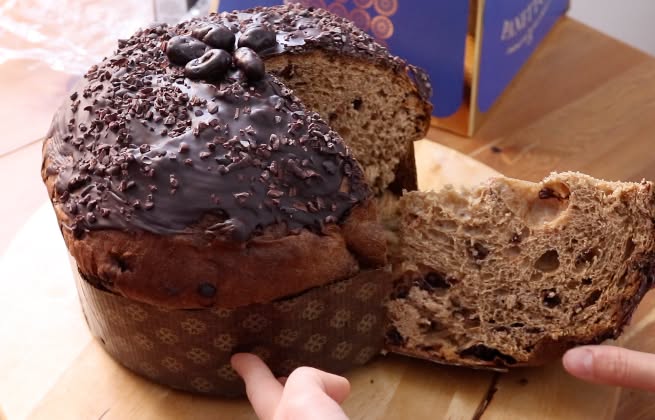
This was the short kind, coated in extra-dark chocolate. Opening it, you smell bread and chocolate with a hint of fruity liqueur; I think the cherries had been soaked. It felt noticeably softer than the supermarket one as soon as I cut it. The crumb had lots of irregular air holes, a sign of a long fermentation, and the chocolate and cherries were evenly spread. Moist and springy, with a little chewiness when torn, and the flavors came in layers: chocolate, bread, then a soft cherry liqueur. An excellent panettone, in my opinion.
TIRI: so close to perfect it made me cry
That year, TIRI had the highest score in the Gambero Rosso panettone ranking. They’re regular winners, with plenty of awards for both the bread and the packaging. Thanks to a friend in Milan, I finally got to meet one.
OK, I admit it: the packaging alone made me tear up (I judge by looks). Blue and gold, elegant and grand, completely my style. The label lists the bread and the caramel separately: the bread is all natural, while the caramel has emulsifiers and flavorings.
Opening it: a rich smell of toffee and bread. The caramel is drizzled in a crisscross on top, and you can see where the loaf cracked naturally as it rose in the oven. Another short one, but it puffed up like crazy, the top almost as big as the body. I couldn’t help poking the top first: soft and squishy, like a pillow. When I cut it, the bread followed the knife. And look at those air holes! A perfect natural sponge. A panettone fermented for 72 hours really is something else.
Fiasconaro, Sicily: candied citrus and saffron
There was a fourth, thanks to a good friend: candied citrus and saffron from Fiasconaro in Sicily. When it comes to citrus, Sicily is the best in Italy, no contest. I ate it before Christmas, so all that’s left is the box: a beautiful hand-painted Sicilian-style tin, designed with Dolce & Gabbana. Great bread, and great packaging too.

How to choose a good panettone
Friends always ask me: Adele, how do I pick a good panettone or pandoro?
1. Read the label: shorter is better
When it comes to ingredients and craftsmanship, that’s the one rule. Milk powder, egg white powder, flavorings and emulsifiers usually mean a factory loaf.
2. Know the price ranges
- Supermarket brands: €5–10
- Small artisan pastry shops: €20–30
- Famous names: easily €50–60
3. Look inside
A good panettone is very soft, with irregular, well-distributed air holes, evenly spread fruit or chocolate, and the right color and aroma. It should be a little chewy, with a stringy pull when you tear it.
4. Be happy
Personally, I think panettone is simply something to keep you company over the holidays. Christmas belongs to everyone, and everyone has their own budget, their own taste, and their own people to celebrate with. Every level has its place. As long as you’re happy, that’s what matters.
I just counted, and we have five panettoni in the house right now.
Pandoro and panmoro
Pandoro
The other Christmas star in Italy is pandoro, “golden bread”: an eight-pointed star shape, with no candied fruit or filling at all, buried under powdered sugar.

Panmoro
In 2024, the most fun new product I found was panmoro, “black gold bread,” named as the opposite of pandoro. The bag comes with a packet of sweetened cocoa powder: pour it in, shake, and the whole loaf gets coated.
Even the bread is cocoa-flavored, with chocolate chips inside and sweet cocoa powder outside. It has a really cheerful cocoa aroma, the kind of bread that puts you in a good mood. Davide said it tastes like Nesquik, and he was spot on.
I asked Giovanni’s two sons to rate it from one to ten: Davide, the younger, gave it 9.5; Antonio, the older, 8.5. Then they tore the whole thing apart.
For a €10 supermarket loaf, don’t judge it like an artisan panettone. It doesn’t have that stretchy, stringy crumb. But honestly, it was surprisingly good.
Here’s the contradiction: I don’t eat chocolate. The darker and richer it is, the less I want it. But anything chocolate-flavored, like chocolate ice cream or chocolate bread, I love.
I bake panettone at home too
After eating so many, I couldn’t resist baking my own. I’ve had plenty of failures, and a few successes.

→ For the rest of a Neapolitan Christmas, see Italian Christmas food: how Naples eats from December 8 to January 6
Related videos
- YouTube: Italy’s most talked-about Christmas bread, panettone
- How to choose panettone and pandoro
- YouTube: Italian Christmas panmoro
Keep reading
- Italian Christmas food: how Naples eats from December 8 to January 6
- Colomba: the Italian Easter dove cake
- Struffoli: Neapolitan Christmas honey balls
FAQ
What is panettone?
A Christmas sweet bread from Milan. The name literally means “big bread.” The classic version has raisins, candied orange and candied citron.
Why is artisan panettone so expensive?
It’s made with Italian flour, fresh yolks, real butter and a natural starter the baker maintains for months, plus additive-free Italian candied fruit, and it takes three to four days from mixing to cooling.
What’s the difference between supermarket and artisan panettone?
Supermarket loaves usually come from industrial lines, with milk powder, egg white powder, flavorings and emulsifiers on the label. They often smell of alcohol when opened and are even but a little dry inside. Artisan panettone has irregular air holes, a moist, springy crumb and layered aromas.
How do I choose a good panettone?
Read the label: the shorter, the better. Inside, a good one is very soft, with irregular air holes and evenly spread fruit or chocolate.
What’s the difference between panettone and pandoro?
Panettone has raisins and candied fruit. Pandoro, “golden bread,” has no candied fruit or filling; it’s an eight-pointed star dusted with powdered sugar.
How long do Italians eat panettone?
From November through January. In many homes, the panettone lasts until Epiphany on January 6.
Adele Liu: born in Tainan, Taiwan, living in Naples for more than 20 years. I cook, I tell stories, and I translate the flavors of two cultures.


Leave a Reply